
The main purpose of restricting access rights to this section is to protect Altegio from changes made without management approval that could harm the company’s image and internal business processes. This permission should be granted only to team members with extended authority (e.g., a manager or company owner).
For example, a receptionist may only need the right to edit team members’ work schedules.
Important
In this section, you can allow or prohibit team members from managing access rights. This setting assumes a team member can manage other members’ access permissions at their own discretion and without approval from management. To avoid such situations, access to this function should be granted only to team members with extended authority.
Setup #
- Go to Settings > Team, select the required team member, and open the Access tab.
- Find the required permission and enable it using the toggle, then click the Settings section name and enable the specific permissions you want to grant the team member.
- To save changes, click Save in the bottom-right corner.
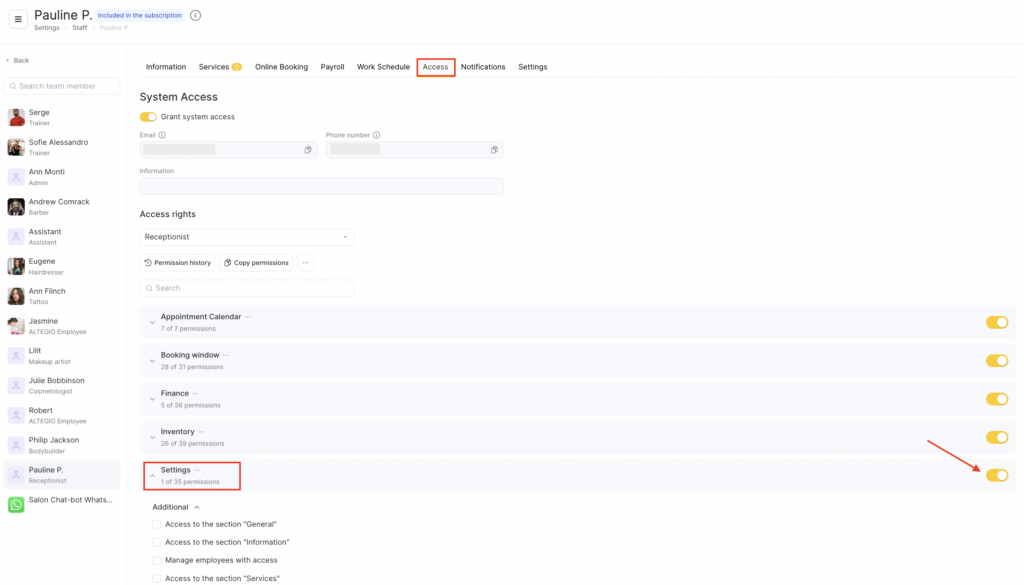
More details about each permission #
- Access to the “General” section
This permission grants access to Settings > My location > Location Settings. If you don’t want a team member to change key location parameters, you should not grant this permission.
- Access to the “Information” section
Grants access to Settings > My location > Business Information, where contact details, location description, photos, and legal/company details are configured.
- Manage team members with access
A root permission that allows configuring other team members’ permissions and managing their access.
- Remove team members with access — allows removing other team members’ access to the location.
Removing access does not delete a team member’s personal account in Altegio; it only removes their access to the location.
- Invite team members with access to location management — allows granting location access to new team members.
- Configure notifications for team members with access — allows managing other team members’ notifications on the Notifications tab in the team member settings.
- Manage team members rights with access — allows the team member to assign and change other team members’ access permissions.
Choose one of the options: - Manage all permissions — the team member can grant and revoke any access permissions without restrictions.
- Manage permissions within their own set of permissions — allows granting only the permissions that the team member has themselves.
For example, if they have the full set of permissions in the Inventory section, but only part of the permissions in the All Clients section, they will be able to grant all Inventory permissions and only part of the All Clients permissions — but not more than they have themselves.
- Access to the “Services” section
A root permission that grants access to Settings > Main settings > Services.
This permission alone is not enough to fully manage services.
With this permission, a team member can: open the Services section, view categories and services, export the service list to Excel.
Any changes in the Services section are available only if additional permissions are granted.
- Create services — on its own, this permission does not allow creating categories and services.
To create them, you also need: the permission to edit services, plus additional permissions listed below. - Edit services — allows editing and deleting categories. For services, this permission allows changing: service type (individual/group), group service capacity, receipt name, repeat-visit reminder settings, membership write-off, translations into other languages, enabling/disabling online booking on the quick-access panel, category and service order.
Additionally, choose which actions to grant access to:
- Service name and online booking name — allows changing the service name. The online booking name can be changed only for a category; for services, the Service display in the widget permission is required. If the service is chain-wide, its name can be changed only at the chain level.
- Service category — allows changing the category the service belongs to. Does not allow editing the category itself. For chain services, the category can be changed only at the chain level.
- Service price — grants access to changing the base service price, team member-specific prices, tax system, and VAT.
- Upload and edit images — this permission alone is not enough. Uploading images also requires the Service display in the widget permission.
- Service display in the widget — grants access to settings on the Online booking tab.
- Online payment for the service — allows configuring online payment for the service on the Online Booking tab. Also requires the Service display in the widget permission.
- Service resources — allows attaching and detaching resources in the service settings.
- Change team member services and their duration — allows assigning services to team members and changing an individual service duration.
- Edit bill of materials — allows attaching bill of materials to professionals assigned to the service.
- Delete services — grants access to deleting services. Deleting chain-wide services is possible only at the chain level.
- Access to the “Team” section
A root permission that grants access to Settings > Main settings > Team.
By itself, it does not allow full team member management — additional permissions are required.
With this permission, a team member can open the section, see the list of team members and part of their settings, but cannot make changes.
- Create team members — allows adding new team members by specifying their name and position. However, to fully set up a team member (assign services, enable online booking, etc.), additional permissions are required.
- Edit team members — allows changing almost all team member settings and expands capabilities during creation.
Does not include:- changing team member’s services — requires Services > Change team member services and their duration;
- managing access rights — requires Manage team member with access;
- managing payroll calculation schemes — requires a permission from Finance > Access to payroll calculation schemes.
- Delete team members — allows completely deleting a team member and all related data.
- Dismiss team members — allows dismissing a team member. Unlike deletion, it keeps all statistics about their work.
- Access to the “Positions” section
A root permission that grants access to Settings > Main settings > Positions.
Only location positions can be edited. Chain-wide positions can be edited only at the chain level.
- Create positions — allows adding new positions via the Positions section or when creating/editing a team member.
- Delete positions — allows deleting positions from the location. Deletion is possible only if no team members are assigned to the position.
- Edit work schedule
Allows configuring the schedule in Settings > Main settings > Work Schedule.
In the new interface, this permission is also required to edit schedules via: the Schedule tab in the team member profile card, and the Team section.
- Access to the “SMS notifications” section
Relevant only for the old interface (Settings > System settings > Notifications). To access notification settings, the Access to Notification types permission is required.
- Access to the “Email notifications” section
Also relevant only for the old interface (Settings > System settings > Notifications). To access notification settings, the Access to Notification types permission is required.
- Access to the “Notification types” section
Allows managing all notification settings in the section: selecting sending channels, changing scenarios, enabling/disabling notification types, editing templates, and managing sending parameters.
- Change Webhook settings
Grants access to Settings > System settings > Webhook.
- Change payment document receiving settings
Allows a team member to change the parameters for receiving payment documents.
- Configure the list of client categories
Allows creating, editing, and deleting client categories, booking categories, and event categories in Clients > Client Categories.